
Size the motor from the motion profile, not the catalogue
A worked ball-screw example: 20 kg moved 200 mm in 0.6 s needs 0.218 N m peak, 0.110 N m RMS and 2,667 rpm. How to get each number and which one actually decides the motor.
A common way to pick a motor is to estimate the load, find something in a catalogue with a bit more torque, and add a safety margin. It often works. When it does not, the axis overshoots, the drive trips on overcurrent, or the motor runs hot after an hour of real duty.
The more reliable route starts from the motion the machine has to make. Once the move is defined, speed, peak torque, RMS torque and inertia ratio all follow from it, and each one checks a different limit of the motor.
The example axis
A horizontal ball-screw axis moves a 20 kg carriage 200 mm. The move takes 0.6 s with 0.15 s to accelerate and 0.15 s to decelerate, followed by a 0.4 s dwell, so one cycle is 1.0 s. The screw is 16 mm in diameter, 500 mm long with a 10 mm lead.
| Input | Value |
|---|---|
| Moving mass | 20 kg |
| Screw lead | 10 mm per revolution |
| Screw diameter and length | 16 mm, 500 mm, steel |
| Screw efficiency | 0.90 |
| Guide friction coefficient | 0.05 |
| Move profile | 0.15 s accelerate, 0.30 s constant, 0.15 s decelerate, 0.40 s dwell |
| Candidate rotor inertia | 0.26 kg cm squared |
Step 1: speed
For a trapezoidal profile the distance is the area under the velocity curve. With equal acceleration and deceleration times, peak velocity is stroke / (accelerate time + constant time) = 0.2 / 0.45 = 0.444 m/s.
Through a 10 mm lead that is 44.4 revolutions per second, or 2,667 rpm. That number alone rules out many small motors and gearmotors before torque is considered.
Step 2: inertia, and the ratio
The carriage reflects to the motor shaft as m x (lead / 2 pi) squared, which is 0.51 kg cm squared. The steel screw itself, as a solid cylinder, adds 0.25 kg cm squared. With 90% screw efficiency, the load the motor sees is 0.81 kg cm squared.
Against a 0.26 kg cm squared rotor that is an inertia ratio of 3.1 to 1. Manufacturer guidance treats ratios around 5 to 1 as typical, with lower ratios giving tighter response and much higher ratios workable when performance is less critical. [1][2] The screw is almost a third of the load here, which is easy to forget when you only weigh the carriage.
Step 3: torque in each part of the move
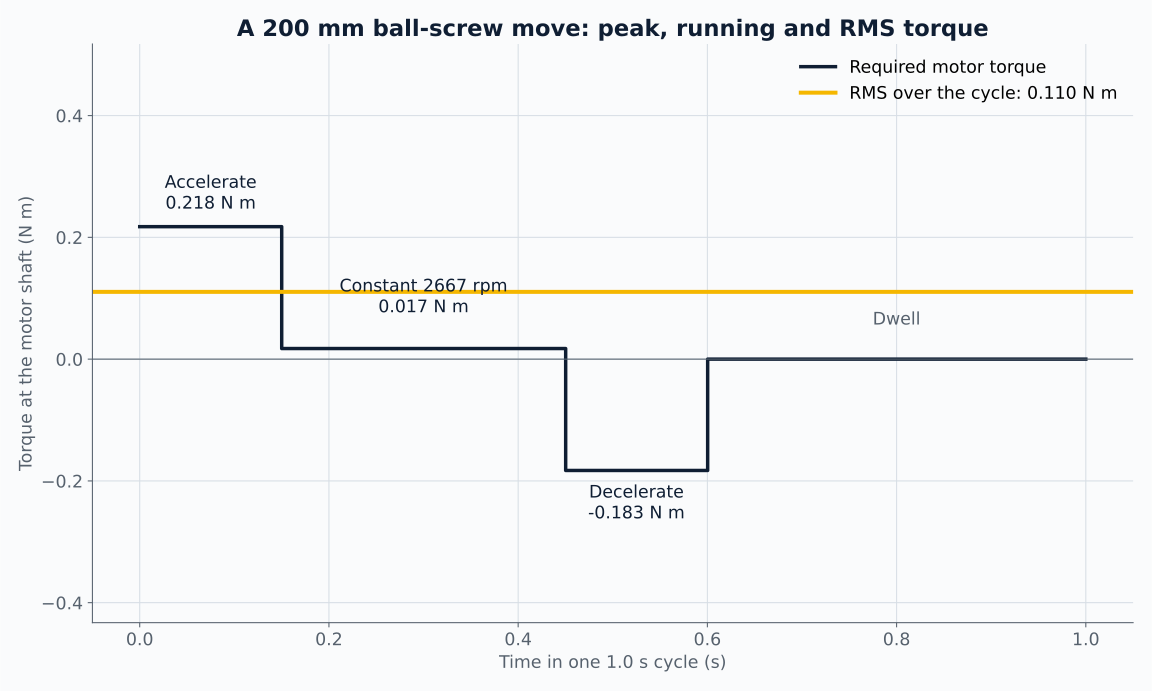
Angular acceleration is the peak shaft speed divided by the ramp time: 279 rad/s over 0.15 s, or 1,862 rad/s squared. Multiply by total inertia, including the rotor, and add friction torque to get the accelerating torque. Friction on the guide is small here, 0.017 N m at the shaft.
| Segment | Torque at the motor shaft |
|---|---|
| Accelerate | 0.218 N m |
| Constant speed | 0.017 N m |
| Decelerate | minus 0.183 N m |
| Dwell | 0 N m |
| RMS over the 1.0 s cycle | 0.110 N m |
Nearly all of the torque goes into accelerating inertia, not overcoming friction. That is typical of fast, short moves, and it is why the acceleration time is the most powerful number to negotiate in a design review.
Which number decides the motor
Each number checks a different limit. Peak torque at the speed where it occurs has to sit inside the motor's intermittent torque-speed region. RMS torque has to sit inside the continuous region, because that is what decides winding temperature. Top speed has to be reachable at the available bus voltage. The inertia ratio decides how hard the axis will be to tune. [1]
Peak torque at 2,667 rpm is where a lot of first selections fail. A motor's peak torque falls off at high speed, so a catalogue figure quoted near standstill can look comfortable and still be short where the profile needs it.
With the numbers in hand, a margin means something: you know which limit it protects. I usually check the profile again with a shorter acceleration time, because someone will ask for a faster cycle once the machine runs.
Sources and further reading
All values are computed from the inputs listed in the article. Coupling inertia is left out for clarity; add it to the load in a real sizing.