
Gendio Display Controller
An ESP32-S3 controller design combining a custom four-layer PCB, serial data handling, matrix-display firmware and a local browser interface.
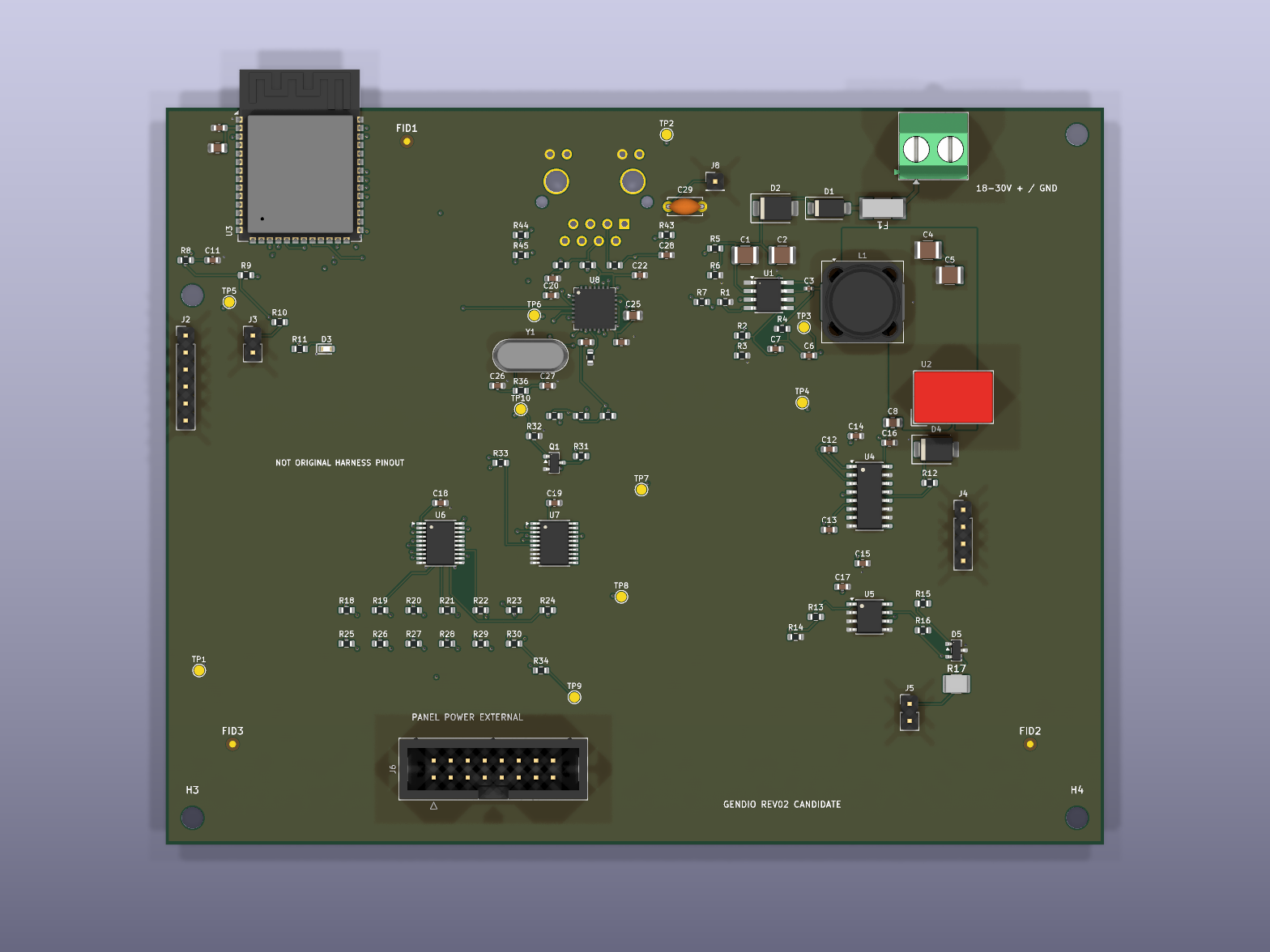
An ESP32-S3 controller design combining a custom four-layer PCB, serial data handling, matrix-display firmware and a local browser interface.
An industrial weight display needs a controller that translates serial data into clear, consistent readings and gives technicians a straightforward way to configure it.
Serial inputs feed a parser and receiver state machine. Display formatting and scanning are separated from configuration and update handling. The PCB design brings together power conversion, processing, serial interfaces and display buffering.
Verification covered the firmware build, synthetic serial-protocol fixtures, host-based display tests, browser workflows and circuit modelling. These checks supported the PCB and software development.
Read the design rationale, verification scope and proposed next experiments.
Read the Gendio Display Controller case studyReviewed schematic connectivity, footprints and connector drills in KiCad, including corrections to the fuse footprint and termination resistor rating.
Compiled the ESP32-S3 firmware and checked image identity, partition placement and non-overlap.
Exercised fragmentation, corruption, timeouts, recovery and counter wraparound across 31 synthetic protocol profiles.
Host framebuffer and GPIO simulations checked glyph fallback, clipping, mirroring, row addressing, clock pulses, disarming and invalid-row blanking.
Tested 31 protocol options and five configuration workflows against a mocked API, including JavaScript error and mobile overflow checks.
Used ngspice for divider corners, reset timing and fixed-duty LC studies, with GNU Octave for analytical load-step and tolerance calculations.
Prepared the board model and mounting exports and matched 88 SMT designators against the placement file.
Have a related engineering problem? Get in touch or explore another project.