
Embedded
ESP32 Ataxia Assessment Device
An ESP32 device with a custom PCB, enclosure, four Hall-effect sensors, 100 Hz acquisition, Bluetooth connectivity and MATLAB validation.
The challenge
Movement and coordination assessment benefits from repeatable sensor-based measurement rather than observation alone.
How the system works
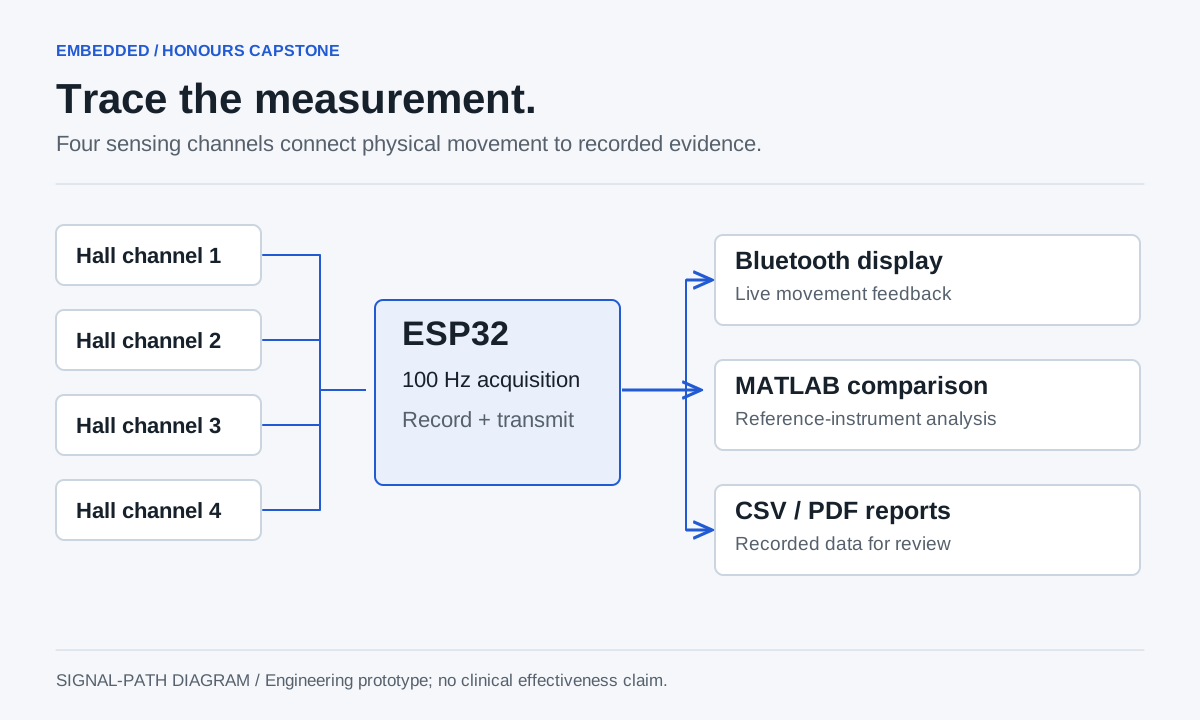
Four Hall-effect sensing channels feed deterministic 100 Hz acquisition on the ESP32. The embedded path supports recording and Bluetooth live display, while MATLAB provides the auditable reference-instrument comparison and reporting workflow.
Design decisions
- Used four Hall-effect sensing channels and deterministic 100 Hz acquisition to capture direction, reversal and movement behaviour consistently.
- Kept acquisition and live display responsive on the embedded system while retaining MATLAB for auditable reference-instrument comparison.
What the evidence shows
Accuracy, direction, reversal, drift and temperature behaviour were checked against reference instruments in MATLAB. This is an engineering measurement prototype; these checks do not establish clinical effectiveness or medical-device certification.
Engineering case study
Go deeper into the design choices, tests and lessons from the project.
Read the ESP32 Ataxia Assessment Device case study