
Robotics
Autonomous Navigation Rover on ROS 2
A differential-drive platform with LiDAR and IMU sensing, running ROS 2 Humble, Nav2, SLAM, EKF state estimation and motion control.
The challenge
Autonomous systems need reliable localisation, mapping and obstacle-aware navigation before higher-level behaviour matters.
How the system works
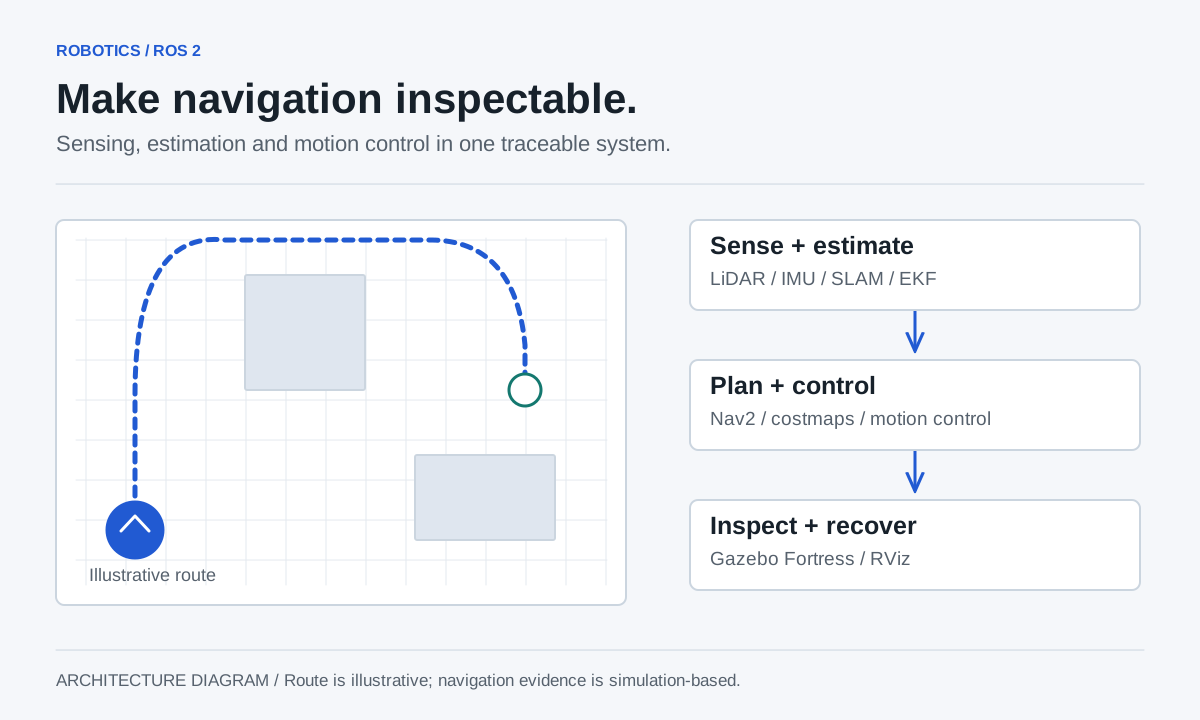
LiDAR and IMU inputs feed modular ROS 2 nodes for mapping and EKF state estimation. Nav2 consumes the resulting map and fused pose for costmaps, planning, control and recovery behaviour, with Gazebo Fortress and RViz providing repeatable inspection.
Design decisions
- Kept perception, estimation, planning and control modular so each layer could be tuned and validated independently.
- Regression-tested planning, costmaps, controller gains and recovery behaviour in simulation.
What the evidence shows
Gazebo Fortress regression runs and RViz inspection checked maps, transforms, fused pose, planned paths and recovery behaviour in simulation.
Engineering case study
Go deeper into the design choices, tests and lessons from the project.
Read the Autonomous Navigation Rover on ROS 2 case study